Why Proper Asphalt Thickness Is Critical for Denver Commercial Parking Lots
Thickness determines whether commercial asphalt lasts 20+ years or fails within a decade. A parking lot carrying delivery trucks, rideshare traffic, employee vehicles, and delivery vans needs substantially more structural capacity than a residential driveway supporting two passenger cars. In Denver, where freeze-thaw cycles and intense high-altitude UV exposure punish pavement relentlessly, adequate thickness becomes even more critical to long-term performance and cost management.
Property managers and business owners often ask for minimum specification standards, looking for the cheapest compliant option. Experienced asphalt companies Denver commercial specialists look instead at how the surface will actually get used, vehicle types, traffic frequency, load concentration patterns, and operational demands. At DMH Site Services, we design asphalt paving Denver thickness around real traffic patterns, actual load weights, and specific site conditions so pavement performs reliably year after year instead of requiring constant emergency repairs.
As an established Denver commercial asphalt company that’s specified and installed thousands of commercial projects, we’ve seen both the consequences of under-specified thickness that fails prematurely and the long-term value of properly engineered installations that outlast expectations and deliver superior lifecycle economics.
Understanding Commercial Asphalt Thickness Standards
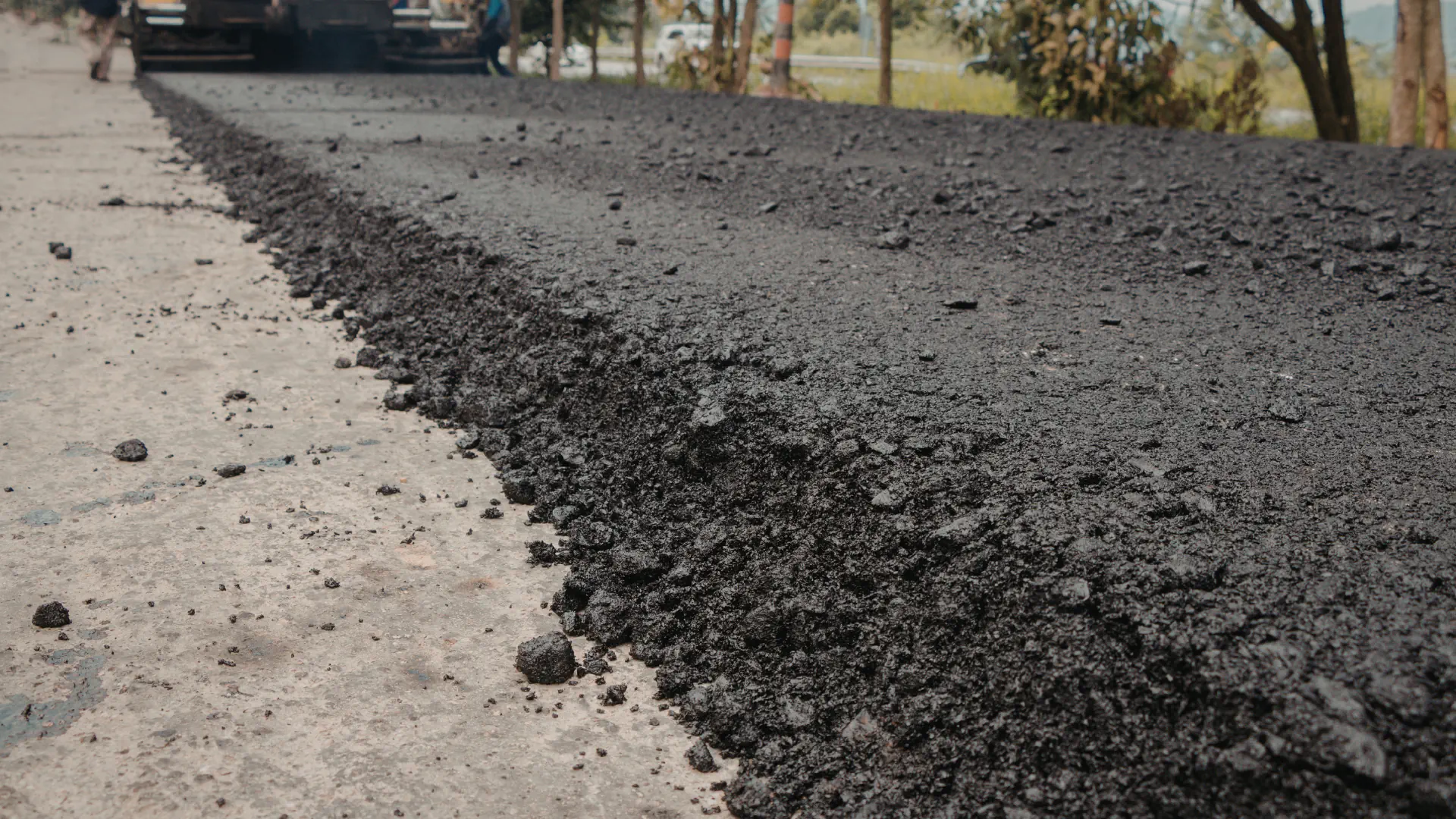
Commercial asphalt typically measures 4 to 6 inches thick after compaction, installed over a properly prepared and compacted aggregate base layer. This thickness specification supports daily vehicle traffic loads, resists rutting and permanent deformation, reduces cracking under Denver’s extreme temperature swings, and provides the structural capacity needed for long-term commercial use.
Light-duty commercial areas such as standard office parking stalls, employee parking zones, and low-traffic perimeter spaces often perform adequately at the lower end of that 4-6 inch range. High-traffic areas like main drive lanes where vehicles pass continuously, entrance and exit routes experiencing turning and braking forces, loading zones and delivery areas supporting heavy trucks, and fire lanes requiring emergency vehicle capacity typically require thicker asphalt specifications, often 6-8 inches or more, plus reinforced base layers to prevent structural failure.
Using correct thickness specifications from project start costs more upfront, typically 30-50% more than under-specified alternatives, but dramatically reduces ongoing asphalt maintenance Denver costs, eliminates emergency patching and repair disruption, prevents premature replacement expenses, and provides predictable performance that supports operational planning. When pavement thickness matches real-world use demands, commercial asphalt delivers the 15-25 year lifespan property owners expect.
At DMH Site Services, we approach thickness specification as engineering, not guesswork. We evaluate expected traffic volumes and patterns, vehicle types and weights, turning radius requirements and stress concentrations, drainage conditions and water management needs, and Denver’s specific climate challenges. This analysis informs thickness recommendations that balance performance requirements with budget realities, neither over-building where unnecessary nor under-specifying where failure becomes inevitable.
Why Denver’s Environment Makes Thickness Critical
In Denver, many commercial parking lots fail first in main drive aisles and entrance areas rather than in parking stalls, sometimes showing serious structural problems in high-traffic lanes while stalls just feet away remain serviceable. This pattern reflects load concentration combined with inadequate thickness specifications. Delivery trucks, service vehicles, and the constant stream of traffic through drive lanes create cumulative stress that under-specified pavement simply cannot withstand.
At DMH Site Services, we routinely specify differential thickness across commercial properties, thicker asphalt or enhanced structural reinforcement in predictable high-load areas, standard thickness in parking stalls and low-traffic zones, and strategic transitions between sections to prevent edge failures. This targeted approach prevents recurring damage in the same problematic locations, extends overall lot life by 5-8 years, and reduces total lifecycle costs compared to uniform minimum-thickness installations.
How thick should commercial asphalt be?
Most commercial asphalt paving Denver projects install at 4 inches minimum thickness, with 5 to 6 inches strongly recommended for properties experiencing regular truck traffic, delivery vehicles, or heavy employee parking loads. Loading docks, truck routes, dumpster pads, and other concentrated-load areas typically require 6 to 8+ inches or significant structural design modifications including reinforced base layers, geotextile fabric reinforcement, or specialized mix designs.
Thickness decisions should always reflect actual traffic characteristics and operational demands, not just lot square footage or minimum code compliance. Two identically sized parking lots may require completely different thickness specifications based on usage patterns, an office park with primarily passenger car traffic needs less structural capacity than a warehouse facility serving heavy delivery trucks daily.
Professional asphalt companies Denver commercial specialists like DMH Site Services evaluate several factors when recommending thickness:
- Vehicle types and weights: Delivery trucks, buses, and service vehicles create far more structural demand than passenger cars
- Traffic frequency: Lots with 100 vehicles daily need different specifications than those serving 1,000
- Load dwell time: Parking stalls where vehicles sit stationary stress pavement differently than drive lanes with moving traffic
- Turning movements: Areas where vehicles turn, brake, and accelerate experience higher shear stress
- Operational requirements: Properties needing commercial snow removal Denver CO services should account for plow equipment loads
- Expected lifespan: Properties planning 25+ year service life should specify thickness accordingly
These factors interact with Denver’s climate challenges, extreme temperature cycling, frequent freeze-thaw, and intense UV exposure, to inform appropriate specifications. What might be adequate thickness in moderate climates often proves insufficient here.
At DMH Site Services, we also consider how thickness decisions affect complementary investments. If you’re specifying adequate asphalt paving Denver thickness to achieve 20-year lifespan, coordinate that with durable parking lot striping Denver materials and comprehensive asphalt maintenance Denver programs that protect your structural investment across its intended service life.
How thick is the asphalt in a parking lot?
Parking lot asphalt in Denver typically ranges from 4 to 6 inches thick after compaction, though this varies significantly based on lot-specific factors. Standard parking stalls in low-traffic areas often install at the lower end of this range (4-4.5 inches), while main drive lanes, entrances, exits, and high-traffic circulation routes typically require the upper end (5-6 inches) or more due to repeated vehicle movements creating higher cumulative stress.
The thickness variation within a single parking lot reflects engineering reality, not all pavement sections experience identical loads and stress. Strategic thickness variation installed during initial asphalt paving Denver construction costs modestly more than uniform minimum thickness but delivers substantially better long-term performance and lifecycle value.
Areas requiring thickness consideration in commercial parking lots include:
- Main entrance/exit drives: 5-6 inches minimum, often 6-8 inches for high-volume facilities
- Primary circulation aisles: 5-6 inches to handle continuous traffic
- Parking stalls (standard): 4-5 inches adequate for passenger vehicle loads
- Loading zones/delivery areas: 6-8+ inches to prevent rutting from heavy vehicles
- Fire lanes: 6-8 inches to support emergency vehicle weight
- Perimeter areas: 4-5 inches typically sufficient for occasional use
Experienced asphalt companies Denver contractors design these thickness transitions carefully to prevent edge failures and ensure smooth vehicle operation across section boundaries.
Parking lot thickness also affects maintenance effectiveness and costs. Adequately thick pavement responds better to asphalt maintenance Denver programs, crack sealing and sealcoating protect sound structure effectively, while thin pavement deteriorates despite maintenance efforts. Properties with proper thickness specifications typically spend 40-60% less on maintenance and repairs over 20 years compared to under-specified lots requiring constant attention.
At DMH Site Services, we’ve managed hundreds of parking lot specifications across Denver’s commercial property market. The consistent pattern: properties that invest in adequate thickness upfront avoid the cycle of repeated repairs, emergency patches, and premature replacement that plague under-specified installations. The initial 30-40% thickness premium typically returns 300-500% value through extended life and reduced maintenance costs.
How much does a 20×20 asphalt driveway cost?
A 20×20 driveway equals 400 square feet. In the Denver area, residential and light commercial asphalt driveways typically cost $7 to $15 per square foot, placing total project costs between $3,000 and $6,000 depending on specifications and site conditions.
Several factors significantly influence final pricing:
Asphalt thickness: 2-3 inch residential specification vs. 4-5 inch commercial-grade substantially affects material costs and installation time
Base preparation: Depth, material quality, and compaction standards drive cost variation
Drainage requirements: Site grading, drain installation, and water management complexity
Access constraints: Difficult equipment access increases labor time and costs
Removal requirements: Disposing of existing pavement adds $2-4 per square foot
Site preparation: Grading, excavation, and soil stabilization needs
While these numbers apply to smaller residential driveways, the per-square-foot principles scale for commercial work. Large commercial asphalt paving Denver projects often achieve better rates ($5-10 per square foot for standard specifications) through volume efficiencies, but complexity factors like thickness variation, drainage engineering, and quality control add costs that smaller projects don’t incur.
At DMH Site Services, we emphasize that thickness and base preparation represent the most cost-effective investments in pavement longevity. Upgrading from 3-inch to 5-inch thickness might add $800-1,200 to a 400 square foot driveway but typically extends functional life from 10-12 years to 18-22 years, dramatically better cost per year of service.
For commercial properties, coordinating asphalt paving Denver work with related improvements maximizes value. When equipment and crews are already mobilized, adding professional parking lot striping Denver services, working with trusted concrete contractors Denver professionals on complementary site work, or scheduling around commercial snow removal Denver CO season creates efficiencies that reduce total project costs while improving overall results.
How thick is the asphalt in a car park?
Car parks (parking facilities) use the same thickness standards as commercial parking lots in the United States. Expect 4 to 6 inches of asphalt over a properly compacted aggregate base, with thickness variation based on traffic patterns and load requirements within the facility.
Multi-level parking structures often use slightly different specifications than surface lots due to additional considerations:
- Structural integration: Asphalt thickness must coordinate with concrete deck structural capacity
- Weight constraints: Building load limits may affect total pavement system weight
- Drainage requirements: Enclosed structures need more aggressive drainage design
- Traffic patterns: Parking structure ramps and turns create higher stress concentrations
Surface parking facilities follow standard commercial asphalt paving Denver thickness specifications, with strategic increases in high-stress areas. Areas handling heavier vehicles, delivery zones, bus stops, RV parking, should increase thickness specifications to 6-8 inches minimum to avoid rutting, prevent structural deformation, and extend functional lifespan.
At DMH Site Services, we’ve specified parking facilities ranging from small surface lots to large multi-level structures. The engineering principles remain constant: match thickness to actual loads and usage patterns, design for Denver’s climate challenges including freeze-thaw and UV exposure, integrate pavement specifications with comprehensive asphalt maintenance Denver programs, and coordinate with complementary services including parking lot striping Denver and work by experienced concrete contractors Denver professionals.
Making Informed Thickness Decisions
If you manage commercial property in Denver and want asphalt that delivers reliable long-term performance instead of requiring constant repairs, thickness decisions matter enormously. DMH Site Services can evaluate your property’s traffic patterns, usage characteristics, existing pavement condition if relevant, site-specific factors affecting performance, and operational requirements to recommend optimal asphalt paving Denver thickness specifications that balance upfront investment with lifecycle value. Contact DMH Site Services for a complimentary thickness specification assessment. We’ll evaluate your current or planned pavement, discuss your operational requirements and traffic characteristics, explain thickness options and their performance implications, and provide transparent pricing showing both initial investment and projected lifecycle costs. No pressure, no cookie-cutter recommendations, just professional engineering guidance from an experienced Denver commercial asphalt company that’s been helping Denver commercial properties make smart pavement specifications for decades.